lunes, 19 de abril de 2010

Guasacaca

I was killing dead hours around the internet, when I found this Video, It is a simple recipe, and it is true, we use this for barbecue, among other things. 

We have traditions in here, when we get all together, let's say with the family, you end up in a place crowded with relatives, that maybe you haven't seen in a while (or those you've been seeing for too long), we eat. What do we eat... Well... Most of Venezuelan would say: Meat!... or well... Like we like to call it: Parrilla!. You might be wondering why. I have, and I've been talking to my friends, just to know the reasons they use to make this awesome plate (or, like you call it: Barbecue).

Most men told me that it is how it is done (Yeah, I know, they are not too specific, but I did not surrender there and kept asking). Then I asked why did they liked the Parrilla (barbecue) and they told me that they just like the flavor of the meat when it is cooked over the fire or coil. It is about taste. Is it about that primitive instict? Well... I don't have the resources to make a deep investigation, so... I can't go in that right now... But in the future, I'd love to do it. When I asked what was the side dish, I found out that they don't really care, or didn't care TOO much. It is about the meat. That's it. Again, I had to go deep on them, so I asked what did they eat like a side for their meat, some said that they liked fried or boiled "Yuca" (Cassava), salad (consisting in lettuce, tomatoes, onions and cucumber), "Bollitos de maíz dulce" (Those are little boiled buns of sweet corn, in tiny peaces of corn leaves), and of course, Arepas.

After this, I asked women about the same topic. Most of them said that they liked the parrillas, but just a tiny little portion of meat, and a lot of salad, with maybe one piece of cassava, and one piece of sweet corn boiled buns. I asked them if they liked "parrillas", and most of them answered that they liked it, but not too often, and they rather to eat smaller portions. So, for most of the women I asked, the meat is not the main ingredient or food when it comes to Barbecue, it is about the side dishes. Cool fact, isn't it? (I love meat, personally, and I eat more meat than salad when it comes to barbecue... no wonder I'm gaining weight!).

Something I realized about both, men and women, they all said that the Guasacaca is a side dish, and not just a simple sause or gravy, it is an essencial part of the barbecue.

It looks like this:


Want to know an interesting fact? When I asked who cooked the Barbecue, they always answered with: My dad, husband, boyfriend, brother, uncle, etc. Why is that? The meat most be cooked by a man in the family. 

When I realized that, I started thinking... Well... who makes the cassava, the arepas, salad and side dishes? The man of the family? No. The woman. Or a group of women. Who season the meat? the woman. Who cleans the dishes? the woman. Hmmm... pretty unfair, isn't it?

Ok... coming back to the subject, the guasacaca it's so traditional, that we eat it even with the empanadas (this is a plate I will talk about later), and there's some people who might eat it with their hot dogs. And yes, it is a very tasteful thing. It is made with avocados, and I know it is a fruit, but we eat it as a vegetable. We use the avocados in salads mostly. But this sauce WILL make the next barbacue you make, a BIG hit. Trust me.

Oh! I almost forgot, here you can watch how to make it... It's very simple and easy, anyone can make it. And If you don't have a food processor, you can use the blender. I have and the sauce gets even creamier. 

Thanks for reading!

sábado, 10 de abril de 2010

Ají Dulce (Sweet Pepper)

Have you ever tried Venezuelan food before?, If you have, then you know that particular taste it have, if you haven't, then this is the entry for you (if you want to know more about the wonderful Venezuelan food).

This are Ajíes Dulces (Sweet Pepper)
Don't they look pretty? Like tiny little peppers, and they actually are... They have a particular taste, and they actually aren't that spicy, and I've heard about those tiny little bombs out there that just cut your tongue, and the rule about peppers are usually true: The smaller they are, they use to be hotter, and spicier, so keep that in mind, and don't mixed this kind with the hotter one... they are very similar, and take that from someone with experience (yes, me... burnt my mouth, even my lips with a tiny little chili).

So, how come Venezuelans love this kind of pepper to cook?
Actually, I have no idea... And I can't really say why it is so common in the market, and you kind find this in every single house, but I can swear it has an important reason.

Some wise guy told me once, that If I wanted to know a city, I had to go to their market. And I've been going to the market with my dad since I was a little kid... He showed me how to select vegetables, fruits, herbs, and everything you might need to cook (He even taught me to pick fish, meat and chicken), And I always noticed that in the popular markets; besides you have to wake up at 4 am, to be there at 5am and get the good stuff; there is always tons and tons of Sweet Peppers, and most people always bought at least a dozen. That actually indicates that they cook using a lot this particular ingredient, but don't get me wrong... they don't use it like an actual ingredient... they use it like a Condiment!!! In soups, stews, gravy, sause, grills, everything!

Soon I'll post a recipe about this... I promise!

lunes, 29 de marzo de 2010

Sun, beach, shopping and a Japanese-Peruvian Mixed food.


I'm in a sunny island... near the beach, with my family... Is so hot, and the humidity is so intense, that I keep feeling like getting in the water, swim and then eat something like fish or so.

Yesterday I spent the day with my sister and my mom buying some things in a mall... You know how it is when you're shopping: You get hungry. We ended up in a sushi restaurant (Because I just love japanese food), and ordered this amazing soup. It was called "Chupe de Camarones", that means shrimps chupe. If you are a japanese food lover like me, you might say: "Hey!, wait a minute, that's not japanese", and you'd be right. This restaurant is a japanese-peruvian mix. Again you'd wonder how can that be. And I don't really have an accurate answer for you. But I do have some theories about that. 

One of them is that many japanese ended up in Perú during War, settled up there and mixed their food (and I know this seems to be an copy paste from some previews entries, but I really think that people mix their food with local food when they migrate, I do). Another one is that the chef is from Peru, loved Japanese food, like I do, and just mixed that up with food he loved from his country. How or why he ended up in here, I have no idea, but I just love this tendency. And is not new, I bet you know about NOBU, and of course it's a mix from these two cultures and food. No mystery there, huh?.

Ok, so, we ordered this soup, and I was kind of waiting for some regular food, or maybe an Ok food. After all, is not common to find good sushi places in this island, but I was very surprised when I took the spoon to my mouth: It was perfect!. It had an exceptional flavor, it mixed spice, with a little bit of sweet, salty flavor, and of course, you could feel the shrimp in the broth and there were shrimps, but you could totally feel that kind of neutralized by cream and tiny chunks of white cheese. It hadn't a fishy flavor, it was a perfectly cooked, and perfectly Perfect soup... And I don't say that about everything I eat... not the word perfect...

It had this color that kept me thinking about what did they used to color it up... 

I couldn't feel tomato in the soup, neither Onoto, that is a very used spice in my country to get things colored up... I had to talk to the chef, or the intrigue wouldn't let me sleep at night. It turns up that the used some kind of pepper (called Ají Panca), that is very common in Peru. The chef even told me where to find it, and how to use it, but I wouldn't dare to recommend that until I've tried it out before... And of course, I don't have the recipe of this Amazing Chupe, but if you ever come to Margarita, I highly recommend this place to you, is called Bushido, in Rattan Plaza. It is the most amazing Chupe you'll ever have!

miércoles, 24 de marzo de 2010

The Silence get us no where

I'm hearing some music right now.. and I was gladly surprised when my ipod chose Staind "For you"...
"I sit here locked inside my head, remembering everything you've said, the silence get us no where, Get's us no where way too fast"

That was my favorite song when I was a teen... And I remembered things that happened back then... the boyfriend I had, the friends that spend time with me near a pool, and the time I met a Chef. He was the father of a friend of mine. Once, at his house, we got hungry, and since I was the only girl there and I refused to eat pasta, they made me cook something. I ended up cooking chicken with orange. Nothing elaborated, I didn't even followed a recipe... Just let my instincts cook... When my friend father came home, smelled the air and asked who cooked, obviously, I was so nervous that I didn't want him to know that I cooked, and used his beautiful kitchen to make my mess... 

After I left their apartment, my friend told his father that it was me who cooked. The next time I went there to visit, his father asked me to cook with him, and taught me some things... he told me that I had a gift, and that if I loved to cook, I should do it. And offered me a job at his restaurant. My mom said no. And I needed her permission to work at that age. That was one of the worst decisions she made about me, but I don't regret it. Now I see the food differently, and I'm  not locked in a kitchen 24/7, but I still want to study Gastronomy... Be a chef, cook, and make everyone say: Oh my god! this is Great!... Soon, I promise to myself.

I was thinking that like a perfume, music reminds you things in your past. When I hear music, i keep remembering things. Californication always reminds me good times, Staind always bring the sad out of me, and Linkin Park always makes me smile, one way or another. I guess that in the future, Lady Gaga will remind me this particular time, when the Ávila is burning and i don't have too many things to cook.

There is a silence... Holy week ahead, everyone will leave the city, I know, I'll be one of them. But just for you to know... I'll bring new recipes soon.

martes, 23 de marzo de 2010

Arepas III

Well... now that I've told you about the fillings of arepas, I think it's time to talk about types of arepas. Something we most say, is that when Columbus arrived, changes started to appear in both kinds of people, natives and europeans, but mostly because there were a crash between cultures. Ok, so... european ate and still eat bread made of wheat, right?, well, back then, as I said, natives ate corn... they learned ways to eat that, that's why most of typical food in Latin America have at least one product involving corn. In Venezuela, for centuries and until half of XX century, were known two types of bread: "Pan-de-trigo" and "Pan-de-maíz", that translates literally in Wheat Bread and Corn Bread, until the name "Pan" that translates Bread, is only used to bread made of wheat. But there were some cleaver marketing man, that used the word PAN to corn flour that is used to make arepas... when you look carefully you see little dots between the letters.. Wanna see?
Of course, there must be an image of a colorful woman (yes, black woman, afroamerican woman... yes, I know, but in here, most of the slaves cooked the arepas for the white masters... and there's even a belief that dark colored women makes better arepas than the white and pale ones... ), So there you have some kind of a joke if you look closely, this is not just Corn Flour, no... It is Flour so you can make YOUR bread... PAN-BREAD. It makes me smile sometimes...

Ok... moving on... depending on the region you are, you might find variations on the Arepas you eat. Per example, in Mérida, Barinas or places in the occident of my country,You might find Arepas Andinas (I will not translate that), that is not entirely made of corn, actually.. there is not even  a grain corn in them... but is not exactly a bread.. It has the shape of a arepa (that means flat and circular), and it is made like a bread, with different ingredients (If you want the recipe, ask for it!! Join my blog and I'll give you the recipe!) 
Kinda looks like a flat piece of bread... but I swear, it's very tasteful, and we call that Arepa too... even when is not corn in it.

Let's continue with this, there's also Arepas de Maíz Pilado. This has actually no valid translation, so I'll tell you what it is about. This is when the lumen and the husk has been removed from any kind of corn, this is the types of arepas that I talked about in the previous blog, but from these process you may also find the Yellow colored arepa, that is way more artesian than the one we eat everyday.
Here's a picture of an Arepa de Maíz Pilado Amarilla... Yes... Amarilla means yellow.

We also have the Arepa de Maíz Pelado (peeled corn arepa), better known as Arepa Pelada (Peeled Arepa), this one is made in a way different way, this one keeps its husk, but the corn is boiled with lime to make it soft. Then is grinned until it makes a paste. It keep the values of the lumen and the husk, and it taste more like mexican tortillas. Personally, i just like these when I'm on the road, aside of a big plate of chicken...
Oh yes... it taste better when is cooked with wood... Om nom nom...

We also have Arepas de plátano, or Plantain Arepas! And as you may be thinking, it is made of plantain. In this one you mix the corn dough with plantain, but it has to be very very ripen (is this the term?) and after you mixed it, you cook it as a regular Arepa... Very tasteful, specially with white cheese...

Ok... So I've told you before that I'd give you the recipe for Sweet arepas... and of course I will...
I don't work with USA metric system, so I'm sorry...

1 cup of Corn Flour, or Harina Pan.
1/4 cup of Leudant Flour.
1 Spoon of oil.
3 Spoons of sugar.
1/4 cup of Papelón rayado... yes, i know you won't find that easily...But try...
Salt
1 Spoon of star anise.
Enough water to make the dough soft and smooth.

In a bowl, mix the two flours with the other ingredients, except for the oil..  mix that until it gets a single texture and color. Then add the oil, followed by the water (I'd use around two and a half cups of water... but is up to you), you most add it in little parts, and never stop kneading, until the dough is firm and soft. You know you used too much water if it turns steaky.

In a frying pan, heat enough oil to fry the arepas. Then, make little balls with it, then squeeze the dough in your hand, not too hard, to make little rounds and flat circles, then put the arepas in the hot oil... Fry until they get a gorgeous golden color, take them out, put them in napkins... you know the process...

I recommend to eat them with white cheese.
Cheers!
Thanks for reading!


jueves, 18 de marzo de 2010

Arepas II

Ok then...
So last time I wrote about the history of arepas in my country... or at least, the one that everyone thinks is the right one.

Let's move on then... There basically two flavors in Arepas: sweet and salty... (and no... there's tons of types... i'll explain them later)
Arepas Dulces, or Sweet Arepas are usually made with Anise and sugar on the dough, some people add milk, butter and other stuff to improve the flavor, and of course, I'll give you the recipe... when we get to the sweet part... But today... I want to talk about Salty ones... or well... the filling we use in the traditional Arepas you'll find in Venezuela... 'cause they are so important in our culture... We love them!!

There's some places in Venezuela called Areperas, there's where you find Arepas, even late at night... And you could say these are fast food restaurants. In these places you can find pretty much everything Venezuelans eat... but arepas are their main attraction. Most places sells arepas that were made on big pans called Budares, usually are white, but you may find it made from yellow dough too... that means that the dough were made using old methods, and use yo be more tasteful. What makes Arepas special on these places are not the arepa "per se", it's the feeling that attracts so many people.

There's so many fillings, that I wouldn't be able to tell them all... But I will Give it a shot.
Starting with traditionals:
- Lard meat. (This is so traditional, that is even on our national dish)
- Stewed chicken (and this varies from place to place... some lard the chicken before they stew it... but everywhere is worth trying)
- Queso de Mano (and this one I won't translate, 'cause its so typical of my country that I don't want it to change... It's a type of cheese, very soft, so moist and delicious that I just can't translate it... sorry) Well... since I feel i'm not even able to describe it... here's a picture!
So... that's how Queso de Mano looks.. and ok... Literally it means Hand Cheese... Funny huh?
- Telita Cheese. That's another variety of white cheese made in Venezuela. It's soft too, but the taste is a little bit different.
- Yellow Cheese. Well... that's it... yellow cheese... lol... tranchettes I belive you call that kind of cheese.
- Reina Pepiada. This should never be translate... it's a words game in Venezuela. It's made with chicken, avocado, and in some cases boiled potato and carrot. Want to see how it looks like?

And this picture comes directly from an Arepera... Cute, huh? See the white thing with black stripes? that's the arepa!!! see all the filling? Yup... that's Reina pepiada.
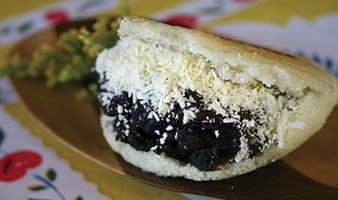
- Domino's. That's an arepa filled with black beans and white cheese.


(i'll make a pause here. What you most understand about my country, is that we have a national plate, what you'll find in that plate: Black Beans, Lard meat, fried Plátano that is some kind of banana and white rice, so you will find those ingredients in many, many traditional dishes, i promise to write about it!)

- Arepa pelúa. This is translated as hairy arepa, it's a very coloquial name for an arepa filled with Lard meat and yellow cheese.
- Catira. Or blond arepa, its filled with stewed chicken and yellow cheese.
- Sifrina. And this I couldn't translate... It's filled with Reina pepiada and yellow cheese.
- Perico. Parrot its the translation... I'm not confortable using that... Its scrambled eggs with tomatoes, onions and salt. Very tasteful... We use to eat this as breakfast.
- Pabellón. Remember when I talked about our national plate... well... put that inside an arepa... without the rice and there you have it.
- Rompe Colchón... Hmmm this is a filling made of seafood, such as pulp, shrimps, oisters among others... and it is said to have afrodisiac qualities.
And of course, there is the Widow or La Viuda... That's an arepa without filling!!!

Well... those are the traditional fillings. But good thing about arepas, is that you can eat them with pretty much anything you want... Even salad. Like I said before: I really think Arepas are better than bread!! -what? I didn't said that before? Sorry!! But they are better!!!- Ok... so, now that you have a pretty good idea of which are the fillings... I can actually talk about types of arepas... But for now... I'll leave you with this, and let you enjoy with your eyes and imagination. Should I leave a recipe? Of Course!!!

To make Arepas for 5 people (and the quantity of arepas depends on how thick you make them)
- 2 cups of Harina Pan (or corn flour... try to use the traditional Arepas kind... otherwise you can end up with something weird)
- 1 teaspoon of salt.
- Sugar. As much as you like it... remember... if you want them salty, don't use too much sugar... I'd say a pinch.
- 2 cups and a half of Water.

In a bowl, put the Corn Flour, the salt, and the sugar... mixed them dry for a little bit... just make sure that the salt goes everywhere. Then add some water... and start mixing it with you hands, like when you make bread... Don't you love when you use your hands?... mix it until you see the texture of the dough don't get stick to your hands, but it most be adhesive. Heat the pan, and when its hot enough, add a little bit of oil to the pan. Make a little ball in you hand with the dough (don't use all the dough!! just a little), and then, firmly squeeze the ball to make a round and flat circle... and put it in the pan... Leave in on a low fire, until you see the crust gets hard and with a lovely brownish color. Some people puts them in the oven for a about 5 - 10 minutes...on a 350 C°... I'd do it, if it's the first time you make arepas... just don't burn them...

Have a great day!!

lunes, 15 de marzo de 2010

Arepas


When I was still studying in the university, I took a course that was called Flavors Antropology. It was a cool subject to see, pretty hard, 'cause is not about recipes, its about food history, food meaning, food in all aspects, except for the cooking part... Well... We NEEDED to know how people cooked because that can tell you a lot about food... But we didn't cooked at class.

I learned that most people don't write about their food... They just don't like to do it if is not a big elaborated plate... With gourmet ingredients, presentation, etc. But what we eat everyday kind of make us who we are "tell me what you eat, i'll tell you who you are" some people say in here. It doesn't mean that you are a cow or a chicken if you eat their meats... don't get me wrong... but it is about what that meat introduces to your body. If you eat meat, red meat, you probably get more lactic acid than a vegan. More cholesterol too... It means that you have to eat that in lower portions. It means a lot of things.

I don't know who was the first one to eat meat... I don't, because it happened when there were no way to record actions and events. I don't know who thought about getting wheat and process it to make flour... I don't even know how people learned what kind of berry were poisonous and what kind of berry were ok to eat. I still don't know how many cultures learned to eat casaba (yuca), mushrooms, cashews, chilies, potatoes, almonds, cherries, apples, and tomatoes... All those are poisonous, and still we eat it every single day in our lifes and no one dies when they eat them... thanks to some cultures, that learned how to eat them, and passed the information foward in their genes.

Venezuela, like most of the American Continents (yes, 'cause they are three: North America, Central America and South America, we share the name AMERICA) changed when the european came in context.. there were wars, there were blood in the ground... but there were also a new culture: the mixed one. Ok... I have to say, I have read tons of books about that period of time, and of course, there's a lot of myths, legends and stuff... But I do think that Spanish conquerers actually learned how to eat corn, they learned how to live eating what natives ate that time, 'cause, come on!, months in the sea, eating rotting food, drinking alcohol and no fresh water... that gotta hurt your body... And these people had tons of fresh water, tons of rare and exotic food (yes, exotic, because they never ate that kind of food before), they called these people barbaric... I think they were pretty much ok, but that's not my point.

My point is... these natives that lived in my country, even before the spanish queen realized that this continent existed, ate corn in various ways. They boiled the corn, then pressed it together, until they had a soft paste, that is nothing more than the dough that we use to make Arepas. That's a traditional food, that comes from the people that lived here, and that passed from mother to daughters, from generations to generations, and now we have it like our very own bread.

Our bread that is wonderful and great, its soft, crunchy and has very nice nutritional properties. Its even better for you stomach than bread... Cool, isn't it? And less calories too, depending on how you cook it. You can make it fried, or baked, or even in a pan... we have electric things to cook them called Tostyarepa... and we eat it any time, any where, any how.

There's a tons of varieties... and i shall share them in my next post... But today... i'll Let you with its story and its meaning to my people, here in Venezuela.

Thanks for reading!